
Product
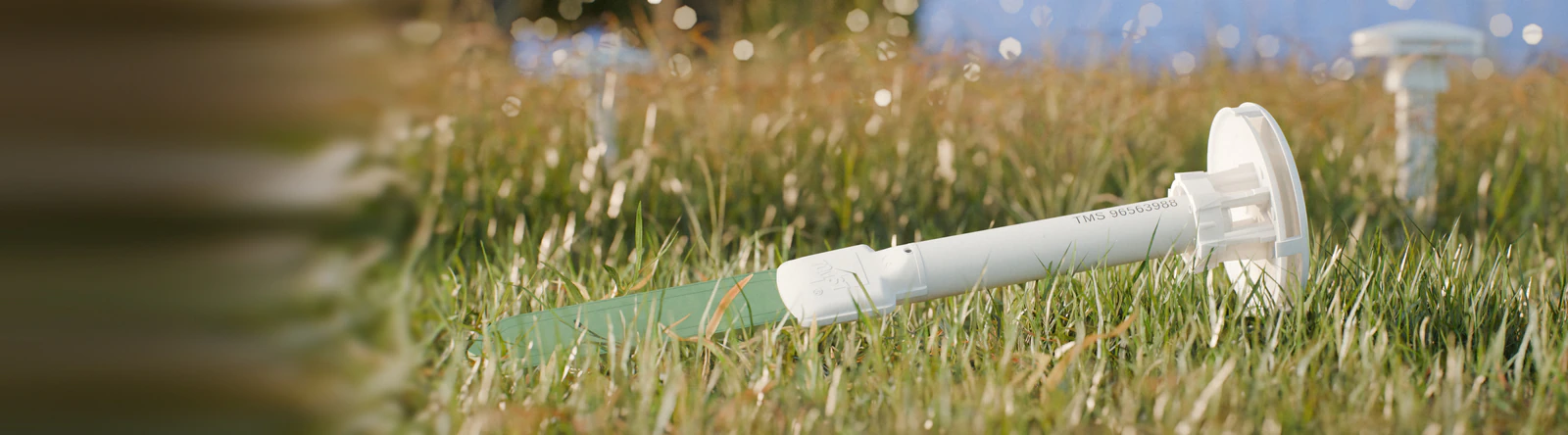
Point Dendrometer
The Point Dendrometer is a potentiometer-based sensor designed for precise, automatic monitoring of stem diameter changes with sub-µm resolution, recorded at user-defined intervals. It also measures air temperature using a thermometer located in the lower part of the body.
Technical specification
- Span
- 8 890 µm
- Resolution
- 0.27 µm
- Linearity
- < 5%
- Battery life
- More than 10 years on the electronics, the same as a TMS Standard. Cell chemistry guaranteed for 10 years by the battery manufacturer.
- Memory
- 507 872 records (about 14 years in Basic mode, one reading every 15 minutes)
- Size of main body
- 25 x 113 mm
That figure is for the electronics. The measurement probe is a mechanical part and does not last as long - in the field it can be fouled or bent, and no point dendrometer design can fully prevent that. If the probe is damaged, the device still records air temperature for a long time afterwards.
How long it lasts (memory & battery)In short
- Records changes in stem diameter at a resolution of 0.27 µm, over a span of 8 890 µm.
- Records by itself at the interval you set; memory for 507 872 records.
- Also measures air temperature, with a thermometer in the lower part of the body.
- Stays on the tree outdoors through every season.
- The same electronics as a TMS Standard: more than 10 years unattended, nothing to charge or service.
- Data is downloaded with the TMD Adapter and Lolly software.
Custom variants
The listed versions are what we keep as standard, but they are not the only thing we can build. Most of the range began exactly this way: the TMS, the Point Dendrometer and many of the variants exist because a research project needed something that did not exist yet. If your deployment needs something the standard range does not cover, write to us at tomst@tomst.com and we will discuss what is possible.
Typical use cases
- Long-term tree growth monitoring.
- Tracking the daily shrinking and swelling of the stem (water status and stress response).
- Forestry, ecology, and climate research.
- Comparing tree response across sites and environmental conditions.
How it is installed
- What you need
- 1. Remove the bark
- 2. Mark the hole
- 3. Drill the hole
- 4. Drive in the mounting screw
- 5. Free the nuts
- 6. Move the cap to the back
- 7. Slide on the dendrometer
- 8. Second nut, then preload
- 9. Lock it
- Done
What matters most
- Scrape off only the outer, hard, dead bark where the dendrometer sits. Not all of the bark, just the outer part.
- Tighten the nuts firmly, really firmly and quite a lot. The dendrometer must not move on its screw.
- Set enough pretension. The tree can and will contract, above all in winter, and the spring must keep the probe pressing on the stem when it does; if the stem shrinks further than the pretension covers, the probe loses contact. Some trees contract more, some less. Installed this way, it is a proven method.
The whole procedure, with all dimensions, is in the installation guide. The pictures of each step, and this animation as a video, are in the illustrations and media.
Download these drawings and the animation